
Abstract
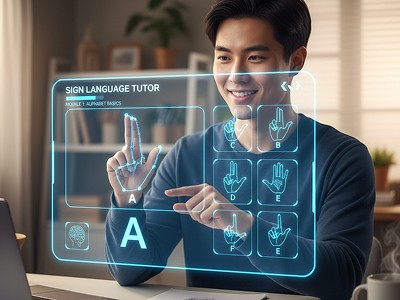
This research explores a real-time system that translates sign language gestures into readable text using computer vision and deep learning. By applying convolutional neural networks to camera input, the system recognizes hand gestures and converts them into English alphabets or words, improving communication accessibility between hearing impaired individuals and others.
Research Context
Communication barriers exist between sign language users and the general population due to lack of shared understanding. The project aimed to bridge this gap by developing an assistive AI-based solution capable of recognizing gestures from live video feeds and converting them into natural language output. The work contributes to accessibility focused technology using machine learning.
Contribution
Role: Team Member (4- Member group)
Responsibilities included:
Assisting in model research and algorithm understanding
Supporting implementation using Python based ML tools
Participating in dataset preparation and preprocessing
Contributing to testing and validation
Documentation and project reporting
Methodology
Image/video captured via camera input
Preprocessing performed using OpenCV and NumPy
Feature extraction and classification using CNN
Model built using: Python, TensorFlow and Keras.
Training with open source or custom sign gesture datasets
Prediction outputs mapped to ASL alphabets/numbers
NLP used to construct readable text output
Key Findings
Demonstrated real-time gesture classification
Accurate recognition of ASL characters from visual input
Showed feasibility of deep learning for assistive communication tools
Validated CNN effectiveness for image based gesture recognition
Impact
Developed practical understanding of computer vision pipelines
Exposure to neural network training workflows
Learned importance of dataset quality and preprocessing
Strengthened collaboration and documentation skills
Sparked interest in human centered technology design